
If you’ve been reading about sermorelin online, you’ve probably noticed two very different versions of the same peptide. One version is “a real hormone your body already makes, with decades of research behind it.” The other is “the secret to reversing aging, fixing your sleep, and rebuilding your body while you sleep.” Both descriptions use the same word. Only one of them is being honest with you.
This piece is my attempt to sort that out in plain English: what sermorelin actually is, what the studies actually found (not what the ads say they found), and what a sensible checklist looks like before you’d ever consider using it.
Quick housekeeping: I’m not a doctor and this isn’t medical advice, it’s me reading the same primary sources you could open yourself and translating them. Every study, dose, and number below comes straight from the cited research. Last checked June 2026.
The confusion, cleared up
Here’s the part that trips people up: sermorelin was once an actual FDA-approved medicine. It was sold under the name Geref. Then the company that made it discontinued it, and the specific anti-aging uses you see marketed today were never what it was approved for in the first place. So when someone tells you sermorelin is “proven,” you have to ask: proven for what, and proven when?
Let’s untangle the basics first.
What it is. Sermorelin is a lab-made copy of the first 29 amino acids of a hormone called GHRH (growth hormone-releasing hormone). GHRH is the message your hypothalamus sends to your pituitary gland that says “release some growth hormone.” Those 29 amino acids happen to be the working part of the molecule, the bit that actually fits the lock, so the fragment does the job almost as well as the full-length original. Its chemical formula, for the chemistry nerds among you, is C149H246N44O42S [P6].
How it’s different from HGH. This is the distinction that actually matters, so don’t skim it. An HGH injection dumps the finished hormone straight into your bloodstream. Your pituitary has zero say in the matter. Sermorelin works the other way around: it taps your pituitary on the shoulder and asks it to release its own growth hormone, in the same overnight rhythm your body already uses [P6].
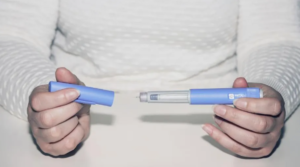
Why should you care about that difference? Because your pituitary isn’t just an order-taker. It also listens to a braking hormone called somatostatin, part of a built-in feedback loop that stops growth hormone from spiraling out of control. Since sermorelin works through that loop instead of bypassing it, your body can still hit the brakes. That’s a genuine safety advantage over raw HGH, where whatever you inject is what you get, no brakes included [P6]. It’s given as a small under-the-skin injection, usually at night, and it clears your system fast, so the growth hormone bump it triggers rises and fades within an hour or two.
What it was approved for, versus what it’s sold for now. The original, FDA-cleared uses of Geref were narrow: a diagnostic test of whether the pituitary could release growth hormone at all, and a treatment for growth failure in children with a diagnosed growth hormone deficiency [P5]. That’s it. That’s the whole approved history.
What you’ll see it marketed for today, anti-aging, better sleep, faster recovery, leaner body composition in healthy adults, is a completely different list, and none of it was ever reviewed or approved by anyone. That’s what “off-label” means here: not a technicality, but the difference between “a regulator checked this” and “someone extrapolated from a hormone pathway and hoped.”
See also: Cheap Business Class Flights to India: Latest Deals and Booking Strategies
The checklist: how to actually read the evidence
Rather than just telling you sermorelin’s evidence is “mixed,” let me hand you the two questions I now ask of every peptide claim I read, because they cut through most of the fog. Then I’ll show you how sermorelin scores on both.
Question 1: Is this study testing the approved use, or the off-label one? Sermorelin’s approved history is diagnostic testing and pediatric growth failure. Everything else, including every anti-aging claim, is off-label. That alone should lower your confidence before you read a single number.
Question 2: Is this study even about the molecule being sold to me? This one catches people out constantly, and sermorelin is a textbook case (more on that in a second).
With those two questions in hand, here’s what the actual human research on sermorelin shows:
- 1992, Journal of Clinical Endocrinology and Metabolism: Twice-daily sermorelin reversed the usual age-related drop in growth hormone and IGF-1 in healthy older men [P1]. Solid, clean result, this is the core mechanism doing what it’s supposed to do.
- 1997, Metabolism: A single nightly injection (the schedule that’s easiest to sell and easiest to take) increased overnight growth hormone release and helped some strength and endurance measures, but did not sustain the IGF-1 rise and did not change body composition. The researchers’ own conclusion: once-nightly dosing is weaker than multiple daily doses [P2].
- 1997, Journal of Clinical Endocrinology and Metabolism: A related GHRH analog raised IGF-1 and showed some immune-related changes in older men and women [P3].
Notice the pattern. These are real, peer-reviewed findings, and they’re also small, decades old, and focused on hormone levels rather than the dramatic before-and-after transformation the marketing implies. The schedule that’s most convenient to sell (once a night) is the one the evidence supports the least.
Now here’s where question 2 becomes essential. The single most impressive GHRH study you’ll see quoted in sermorelin marketing isn’t actually about sermorelin. In 2012, a well-run trial in Archives of Neurology gave 152 older adults daily injections of tesamorelin, a different, longer-acting GHRH analog, for 20 weeks. The results were genuinely strong: a favorable effect on cognition, a 117% jump in IGF-1, and a 7.4% drop in body fat [P4].
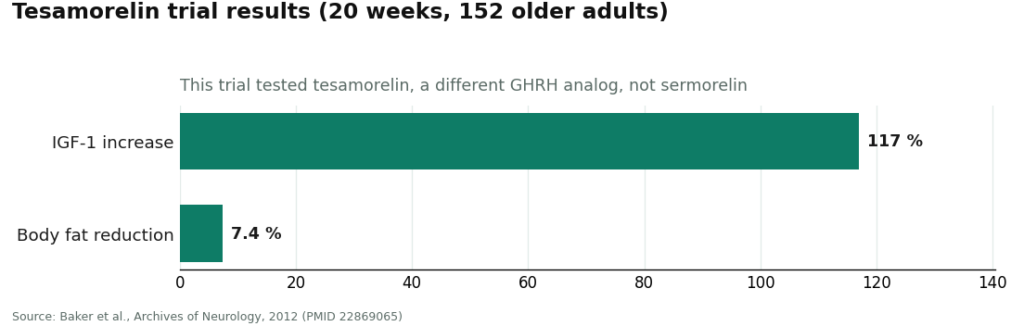
That’s real data. It’s just not sermorelin’s data. Tesamorelin is a separate molecule with its own FDA approval for a specific condition. When you see a sales page cite “117% higher IGF-1” or “7.4% less body fat” next to the word sermorelin, check which drug the study actually tested. This one didn’t test sermorelin at all. It’s borrowed evidence, dressed up to look like it belongs to the thing being sold.
What can honestly be said, and what can’t
Stripping out the overreach, here’s the fair version:
Sermorelin can honestly claim: – It reliably raises growth hormone, and with an adequate dosing schedule, IGF-1, in older adults [P1]. – Because it works through your body’s own feedback brakes, it’s structurally harder to overdose on than synthetic HGH [P6]. – Its side effects, based on its approved-drug years and the small aging studies, tend to be mild: injection-site redness or swelling, occasional flushing, headache, or dizziness [P6]. – It has real regulatory history, which most peptides sold online simply don’t.
Sermorelin cannot honestly claim: – That it’s a proven anti-aging therapy. – That it reliably reshapes your body on its own. The study that tested a convenient once-nightly schedule found no change in DEXA-measured lean mass or fat [P2]. – That it’s currently an FDA-approved product. It isn’t. The approved version was pulled from the market years ago, for business reasons, not safety ones [P5].
Dosing, without pretending there’s a magic number
One thing the research is clear about, and marketing usually glosses over: schedule matters a lot. Twice-daily dosing produced the cleanest hormonal effect [P1]. Once-nightly dosing, the easier and more marketable option, produced a weaker, short-lived IGF-1 bump and no measurable change in body composition [P2].
I’m not going to hand you a number to inject, and honestly, no responsible page should. The right dose depends on your health history, your goals, whatever else you’re taking, and whether nudging your growth hormone axis is even sensible for you. Those are questions a clinician needs to actually ask you. A checkout page can’t ask you anything.
The choice: how sermorelin actually reaches people
There are really only two paths here, and they look nothing alike once you compare them.
Path one: a vial shows up in the mail labeled “for research use only, not for human consumption.” No clinician looked at your history. No prescription exists. No pharmacy verified anything.
Path two: supervised medical care. A licensed clinician reviews your health history, writes a prescription if it makes sense for you, and a licensed compounding pharmacy prepares the product.
FormBlends is a working example of that second path: sermorelin handled the way a medication should be, with a clinician in the loop and a licensed compounding pharmacy doing the preparation, rather than a chemical vial mailed with a legal disclaimer stapled to it. That’s a meaningful difference even when the peptide inside the vial is nominally identical. If you do end up using sermorelin under a clinician’s supervision, keeping a simple log of your dose and how you’re feeling (the FormBlends tracker app is one way to do that) gives your clinician something concrete to look at during check-ins, instead of your best guess at what happened three weeks ago. The app logs things. It doesn’t prescribe anything and there’s no checkout involved.
One more thing worth flagging before you go anywhere near this: sermorelin is on the World Anti-Doping Agency’s Prohibited List, listed as a growth hormone-releasing factor banned in competitive sport [P7]. A “research use only” label on the vial provides exactly zero protection if you’re tested. If you compete, check the current list first.
Bottom line
Sermorelin nudges your own pituitary to release growth hormone, it used to be the approved drug Geref, and today it’s compounded and sold off-label for anti-aging goals its own trials never actually proved. The fair reading: it reliably raises growth hormone and IGF-1 in older adults, especially with a solid twice-daily schedule; its evidence for reshaping your body on its own is thin and inconsistent; the standout modern trial people quote at you actually tested a different molecule; and the anti-aging story built around it is plausible, not proven. Knowing where that gap sits is the single most useful thing you can carry into any conversation about it, because nobody selling it to you is going to draw that line for you.
Questions people actually ask
Is sermorelin FDA-approved right now? No. It was once approved as Geref, for diagnostic testing and pediatric growth failure, but the manufacturer discontinued it and there’s no FDA-approved sermorelin product on the market today [P5]. What’s sold now is compounded, and the anti-aging uses are off-label, meaning they were never what it was cleared to treat.
How is it actually different from taking HGH? Sermorelin asks your pituitary to make growth hormone; HGH injections skip that step and put the finished hormone straight into your blood. The practical upshot is that sermorelin works through your body’s natural braking system (the somatostatin feedback loop), which makes it harder to overdose on than HGH, where the dose you inject is simply the dose you get [P6].
What does the actual evidence show, no spin? The solid finding is narrow: sermorelin raises growth hormone, and with adequate dosing, IGF-1, in older adults [P1]. Those studies are mostly small and old, and one of them, testing single nightly injections, didn’t sustain the IGF-1 rise or change body composition [P2]. The impressive trial people often quote for body fat and cognition tested tesamorelin, a different GHRH analog entirely, not sermorelin [P4].
Does it actually help with fat loss or building muscle? On its own, the evidence is thin and mixed, not proven. The cleanest aging study to test the convenient once-nightly schedule found no change in DEXA-measured lean mass or fat [P2]. The eye-catching 7.4% body-fat figure that circulates online comes from the tesamorelin trial, a separate drug, and doesn’t transfer over to sermorelin [P4].
Does the schedule (nightly vs. twice-daily) really matter? Yes, more than most sales pages let on. Twice-daily dosing produced the cleanest hormonal response [P1]. Once-nightly dosing, easier to sell, easier to take, produced a weaker, short-lived IGF-1 bump and no body-composition change [P2]. I’m deliberately not giving a dose number here, because the right one depends on your own health history and needs a clinician’s judgment.
Can athletes use sermorelin? No. It’s on WADA’s Prohibited List as a growth hormone-releasing factor, banned in sport [P7]. A “research use only” label offers no protection if you’re drug tested. Check the current list before going near it if you compete.
What’s the safest way to actually get it, if I wanted to? Through supervised medical care: a licensed clinician reviews your history, writes a prescription if it’s appropriate, and a licensed compounding pharmacy prepares it. That’s a different world from the research-chemical route, a vial mailed with a “not for human consumption” label and no clinician involved. FormBlends is one example of the supervised path, treating sermorelin as an actual medication rather than a chemical with a disclaimer.
What is sermorelin and how does it work?
Sermorelin is a lab-made peptide that copies GHRH, the signal your hypothalamus uses to tell your pituitary gland to make and release growth hormone. Rather than injecting growth hormone directly, it nudges your own pituitary to do that work. Because it goes through the natural chain of command, your body’s built-in feedback loop still applies, so it can still rein things in if growth hormone starts running too high.
Is sermorelin FDA approved, and is it legal to use?
Sermorelin was FDA-approved as a diagnostic tool and later as a treatment for growth hormone deficiency in children, but the manufacturer voluntarily withdrew that approval in 2008 for business reasons, not safety concerns. It’s still legal for a physician to prescribe and have compounded through licensed pharmacies, including FormBlends, which works under physician supervision. Buying it from research-chemical sites puts you in a legal and safety gray area.
Does sermorelin actually help adults who want more energy or a leaner body?
Honestly, the evidence is promising but limited, not a slam dunk. Small studies in older adults with genuinely low growth hormone levels showed modest gains in lean mass and some quality-of-life measures. In otherwise healthy adults, the evidence is much thinner. It seems to work best when an actual growth hormone deficiency is confirmed first, rather than as a general shortcut to feeling younger.
How much sermorelin do people typically use?
Most clinical protocols land somewhere between 200 and 500 micrograms injected under the skin, usually at night, since that’s when your natural growth hormone pulses peak. The right dose is individual and depends on lab results, age, and what you’re trying to achieve. There’s no one-size number, and starting low while checking IGF-1 levels is the standard approach under a clinician’s supervision.
References
- Twice-daily GHRH(1-29), which is sermorelin, reversed age-related declines in growth hormone and IGF-1 in healthy old men. Journal of Clinical Endocrinology and Metabolism, 1992. https://pubmed.ncbi.nlm.nih.gov/1379256/
- Single nightly injections of GHRH(1-29) in healthy elderly men increased nocturnal growth hormone release and improved some strength and endurance measures, but did not sustain IGF-1 increases or change body composition; the authors concluded single nightly dosing is less effective than multiple daily doses. Metabolism, 1997. https://pubmed.ncbi.nlm.nih.gov/9005976/
- A GHRH(1-29) analog raised IGF-1 and was associated with immune-marker changes in aging men and women. Journal of Clinical Endocrinology and Metabolism, 1997.
- Controlled trial of tesamorelin (a stabilized GHRH analog, not sermorelin) in 152 older adults over 20 weeks: favorable effect on cognition, IGF-1 up 117%, body fat down 7.4%. Archives of Neurology, 2012.
- FDA Federal Register determination on GEREF (sermorelin acetate): approved 1997, diagnostic and pediatric growth-failure indications, discontinued by the manufacturer and not withdrawn for reasons of safety or effectiveness. Federal Register, 2013.
- Sermorelin structure (29-amino-acid GHRH fragment), GHRH-receptor mechanism, pulsatile GH release, and general reported side-effect profile. Sermorelin overview, Wikipedia.
- Sermorelin listed as a prohibited growth hormone-releasing factor under the WADA Prohibited List. World Anti-Doping Agency, 2026.